
Executive Summary:
- The digestive system works in a clear step-by-step process. It follows an order. Each step plays an important role. When one stage is affected, the whole process can be disrupted. Everything is connected closely.
- Waste is also removed efficiently and balance is maintained. For younger learners, the digestive system for kids can be simplified into easy steps. Understanding becomes much clearer. It gets easier. With practice.
- Guidance can also support learning. Students benefit from structured help like PSLE Science tuition. Concepts are explained step by step and confidence improves over time. Small steps matter a lot.
The body processes food systematically. Each step in the human digestive system is important. Each step must occur in the proper order for digestion to work properly. Let’s understand it clearly.
What Is the Digestive System?
The digestive system is a group of organs that work together to digest food. It works together. Waste is removed from the body and balance is maintained.
The digestive system functions ensure that the body gets what it needs to survive. It keeps us going. Every day. This subject is usually covered as part of the digestive system for children. It gives a good basis for the learning of science.
The 6 Steps of the Digestive System
The process of digestion occurs in a certain order. It must be followed.
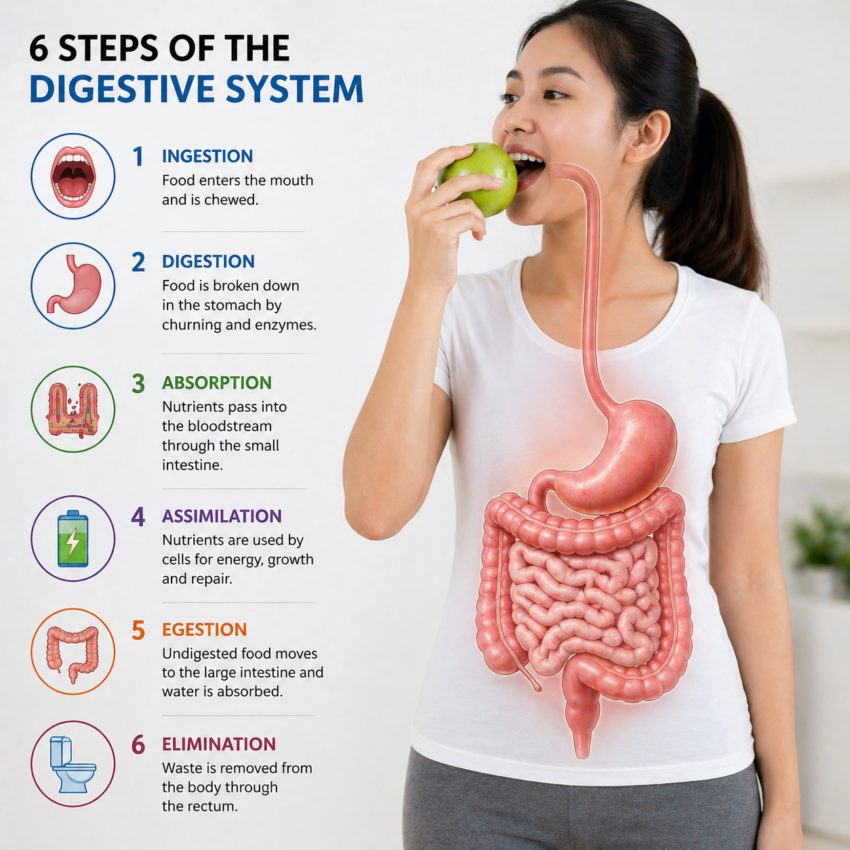
1. Ingestion
Ingestion is the first step. It begins in the mouth. Food is taken into the body and chewing starts immediately. Teeth break food into smaller pieces and saliva is mixed with it to begin digestion. This process makes food easier to swallow. It starts everything.
2. Digestion
Digestion breaks food into simpler forms. It continues in the stomach. Chemical and mechanical processes are involved and enzymes play a key role. Food is churned and mixed with digestive juices and it is broken down further. Nutrients are prepared for absorption. And the process becomes more complex at this stage. It takes time but it works.
3. Absorption
Nutrients are taken up into the bloodstream. This happens in the small intestine. Food that has been digested passes through the walls of the intestines. Useful substances are absorbed into the body. Vitamins, minerals and energy-giving nutrients are absorbed. They are carried to various parts of the body.
4. Assimilation
It puts the nutrients to work. Cells take up nutrients which are utilised for energy, growth and repair. Extra nutrients are stored for later use when needed. It supports life.
5. Egestion
The food that is not digested goes to the large intestine. Water is pumped out of the remaining material and solid waste is prepared for removal. This step is important and helps to keep the internal balance. Your body does the cleaning.
6. Elimination
Waste is removed from the body. It is the final step. The rest of the material is expelled and digestion is completed. The cycle ends. Then repeats.
Making It Easy for Kids to Understand
The digestive system for kids can be explained simply. Simple explanations help children remember the sequence better. It becomes fun and clear.
The Role of Practice and Guidance
Understanding improves with revision. It always does. Students should practise diagrams and label each step and key terms must be remembered. Mistakes are corrected with feedback and concepts become clearer over time. Some learners benefit from extra support and PSLE Science tuition is often chosen to strengthen topics like this.
It builds confidence gradually.
Final Thoughts
The digestive system works in a transparent and well-organised step by step manner. The six stages of digestion students learn about the body’s processing of food. This subject is easy to understand with everyday practice and the right support.
FAQs
Name the 6 steps of the digestive system?
The six steps are ingestion, digestion, absorption, assimilation, egestion and elimination. They follow a sequence. Each step happens in order and food is processed gradually. The digestive system function depends on this sequence and it must be completed properly for the body to work well. It is systematic.
What is the digestive system’s primary role?
It supports the body. Energy is produced from food and nutrients are used for growth and repair. Waste is removed after digestion and balance is maintained in the body.
How to teach children about the digestive system?
Keep it easy. Food goes into the mouth, gets broken down, useful parts are taken by the body and waste is removed. Visual aids and diagrams are often used and they make learning clearer. Simple works best.
