
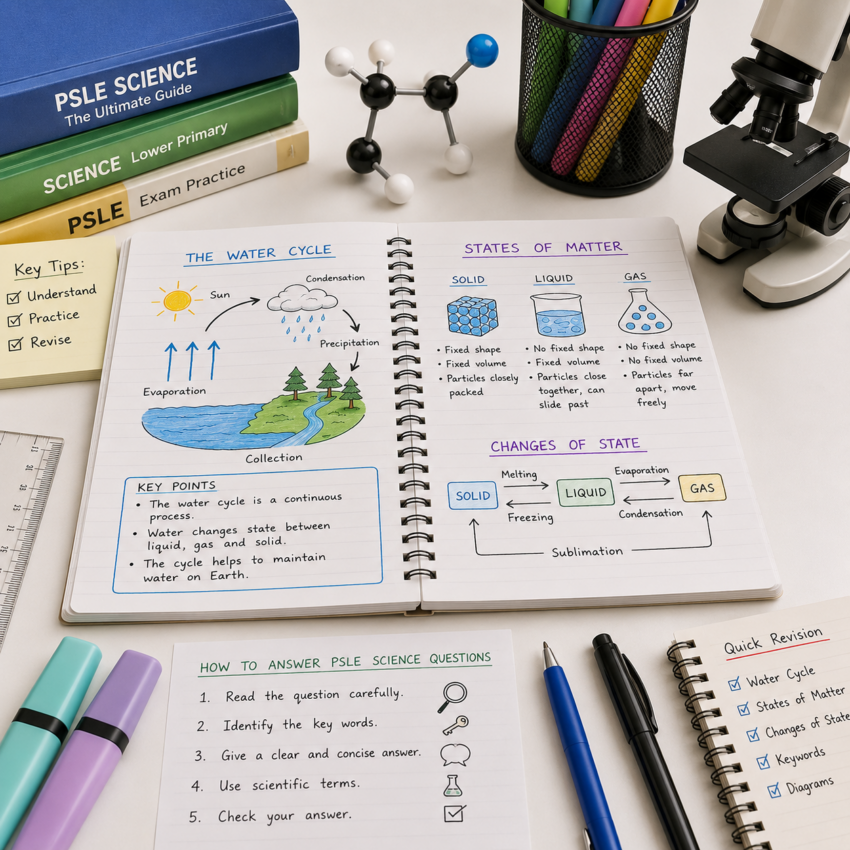
Executive Summary:
- Science cycles are important topics in PSLE Science examinations. Students must understand water cycles and matter changes clearly. Concept understanding improves performance.
- Many students struggle because they memorise answers without understanding the processes properly. Confusion often appears during open-ended science questions. Students should learn how particles behave during state changes carefully. Clear explanations and organised answers usually improve examination scores. Practice strengthens scientific reasoning. Many students also need guidance on how to answer PSLE science questions effectively. Careful reading, proper keywords and logical sequencing improve answer quality significantly. Structure supports clarity.
- Regular revision diagrams and practice exercises also help students remember concepts more confidently. Consistent preparation improves understanding gradually.
Science cycles are important topics in PSLE Science examinations. Many students struggle with these concepts initially. The topics require careful understanding. Water cycles and matter changes are tested regularly during assessments. Students must understand processes, observations and scientific explanations clearly. Strong foundations improve performance.
Some students memorise answers without understanding scientific concepts properly. Mistakes are often repeated during examinations because understanding remains weak. Concept clarity matters greatly. Students who practise regularly usually improve scientific reasoning skills steadily. Confidence is also strengthened through structured revision.
Preparation supports better results.
Many families choose PSLE science tuition Singapore programmes for guided science learning and examination preparation. Structured support often improves understanding significantly.
Understanding Science Cycles
Science cycles explain repeating natural processes and changes. Students must understand each stage carefully. Logical thinking improves understanding. These topics often involve diagrams, scientific vocabulary and process explanations. Clear observations are usually expected during examinations. Accuracy supports better answers.
Students may find cycles confusing because several stages connect together. Weak understanding often causes mistakes during written explanations. Organisation improves clarity.
Strong science learning requires understanding rather than memorisation alone. Concepts should remain connected logically during revision. Understanding strengthens retention.
The Water Cycle Explained
The water cycle describes water movement within nature continuously. Several stages are included within this process. The cycle repeats naturally.
-
Evaporation
Evaporation is the process by which heat transforms water into water vapour. The sun usually provides this heat energy. Heat causes water particles to move faster gradually. Energy changes matter states.
Evaporation occurs continuously during warm weather conditions. The process becomes faster under stronger sunlight.
-
Condensation
This process creates clouds. Cooling changes water states. Water vapour naturally rises in the cooler air. Tiny droplets are then collected together gradually. Cloud formation becomes visible.
Condensation also appears on cold surfaces sometimes. Water droplets may be observed on glasses or windows. Everyday examples support understanding.
-
Precipitation
Precipitation occurs when water droplets become too heavy inside clouds. Gravity affects water movement. Snow hail and sleet are also forms of precipitation. Different weather conditions influence precipitation types greatly. Climate affects precipitation patterns.
Water returns to Earth through precipitation regularly. The cycle then continues repeatedly afterwards. Natural balance is maintained.
-
Collection
Water gathers inside rivers, lakes and oceans after precipitation. Groundwater may also be collected underground naturally. Collection completes the cycle. The collected water eventually evaporates again through heat exposure. Continuous movement keeps the cycle active. Cycles repeat constantly.
Understanding Matter in PSLE Science
Matter refers to anything occupying space and possessing mass. Solids liquids and gases are different matter states. Science explains these changes clearly. Students must understand how matter changes between states. Heating and cooling processes are commonly tested. State changes require careful explanation.
Scientific vocabulary should also be used correctly during answers. Weak explanations often reduce examination marks significantly. Accuracy improves scientific communication.
States of Matter
Each state has different properties and behaviours. Observation supports understanding.
-
Solids
Solids have fixed shapes and fixed volumes. Their particles remain closely packed together. Movement becomes very limited. Most solids cannot flow like liquids. Strong particle attraction keeps shapes stable. Structure affects physical properties.
-
Liquids
Liquids have fixed volumes but changing shapes. Containers determine liquid shape naturally. Liquids can flow easily. Particles inside liquids move more freely than solids. Weaker attraction allows movement between particles. Flexibility increases through particle movement.
-
Gases
Gases have no fixed shape or volume. Movement becomes extremely active. Gases spread quickly within available spaces naturally. Weak particle attraction allows continuous expansion. Energy affects particle motion greatly.
Changes of State in Matter
These changes are important science examination topics. Understanding improves answer quality.
-
Melting
Melting happens when solids change into liquids through heating. Heat increases particle movement. Particles move more freely during melting processes gradually. Solid structures become weaker through energy absorption. Temperature influences state changes.
-
Freezing
Freezing occurs when liquids cool into solids. Water freezing into ice demonstrates this process clearly. Cooling reduces particle movement. Particles become closely packed during freezing stages naturally. Stronger attraction creates fixed structures afterward. Energy loss affects matter states.
-
Evaporation and Boiling
Evaporation and boiling both involve liquid changing into gas. Heat energy is required during both processes. The processes happen differently. Evaporation occurs slowly at surface levels only. Boiling happens rapidly throughout the liquid entirely. Temperature affects boiling directly.
-
Condensation
Water droplets often form through condensation naturally. Cooling reduces particle energy. Gas particles slow down during cooling stages gradually. Liquid droplets are then formed afterward.
Common Mistakes Students Make
Many students memorise science notes without understanding concepts properly. Confusion often appears during application questions. Understanding matters more. Some students forget scientific keywords during explanations. Marks may be lost because answers remain incomplete. Vocabulary affects scoring.
Diagrams are also misunderstood by certain students sometimes. Incorrect sequencing often weakens science answers significantly. Organisation supports clarity. Students may also provide vague explanations during examinations. Specific scientific details are usually expected in responses. Precision improves answer quality.
How to Answer PSLE Science Questions Effectively
Many students ask how to answer PSLE science questions correctly. Strong answering techniques improve examination performance greatly. Important keywords are often missed through rushed reading. Attention improves accuracy.
Scientific terms should always be included during explanations. Clear reasoning strengthens answer quality significantly. Vocabulary matters greatly. Students should also explain processes step by step clearly. Logical sequencing improves readability during marking. Structure supports understanding.
Diagrams, labels and observations should remain neat and organised. Presentation affects clarity during science examinations. Neat work improves communication. Students should practise open-ended science questions regularly before assessments. Familiarity improves confidence during examinations. Preparation reduces stress.
Importance of Revision and Practice
Science understanding improves through consistent revision and practice. Repetition strengthens memory and scientific reasoning. Consistency supports stronger retention. Students should revise diagrams, definitions and science processes regularly. Weak topics become easier through repeated exposure. Practice improves understanding gradually.
Mock examination questions also help students prepare effectively. Mistakes can be corrected before actual assessments. Correction supports improvement. Short revision sessions often work better for younger students. Long exhausting sessions may reduce concentration levels. Balance improves productivity.
Role of PSLE Science Tuition
Many students benefit from guided science support and revision. Structured lessons improve understanding more effectively. Support strengthens confidence. During PSLE science tuition sessions students practise diagrams explanations and open-ended science questions regularly. Difficult topics are usually simplified through guided teaching. Learning becomes clearer gradually.
Many PSLE science tuition Singapore programmes also provide worksheets revision exercises and mock assessments. Students become more familiar with examination expectations. Preparation improves readiness greatly. Tutors often teach students how to answer PSLE science questions using proper scientific keywords and structured explanations. Weak areas are identified through regular correction. Guidance improves performance steadily.
Conclusion
Water cycles and matter changes are important PSLE Science topics. Students must understand concepts clearly for stronger examination performance. Understanding improves confidence greatly. Students who revise consistently usually improve observation and explanation skills steadily. Confidence also grows through correction and preparation.
Consistency strengthens academic performance. With proper support from PSLE science tuition Singapore programmes, students can understand science cycles more effectively. And learn how to answer PSLE science questions confidently during examinations.
FAQs
Why do students struggle with science cycles?
Many students memorise processes without understanding scientific explanations properly. Weak understanding causes confusion later.
How to answer PSLE science questions effectively?
Students should use scientific keywords, clear explanations and organised steps in their answers. Structure improves clarity greatly.
Why are scientific keywords important in PSLE Science?
Scientific keywords improve answer accuracy and help explanations sound more complete. Vocabulary affects scoring significantly.
Why do families choose PSLE science tuition Singapore programmes?
Many parents choose PSLE science tuition Singapore programmes for structured revision and examination preparation support. Preparation improves confidence steadily.
