
The question isn’t whether technology will replace teachers. It’s whether it should.
And in Singapore, that question is being answered in real classrooms – quietly, steadily and with surprising balance.
AI is here. It’s faster than any human, more consistent than any tutor and available 24/7. It remembers every error, predicts learning gaps and personalizes lessons without fatigue. Sounds ideal, doesn’t it? But let’s pause. Something feels missing, doesn’t it?
Because teaching isn’t only about accuracy. It’s about connection.
AI in Classrooms – A Revolution That Doesn’t Sleep
Artificial Intelligence has crept into education like oxygen – invisible but everywhere. From adaptive quizzes to essay feedback, it’s transforming how students learn. Especially in systems like PSLE online tuition, where AI tailors questions to the student’s strengths and weaknesses.
Students who once feared repetitive practice now engage with gamified lessons. Mistakes are analyzed instantly. Progress is charted. Learning becomes efficient – almost mechanical in its perfection. And yet, while AI personalizes, it doesn’t personify. There’s no raised eyebrow when a student hesitates. No encouraging nod. No quiet reassurance that you’re doing fine.
Teachers Bring Humanity, Not Just Knowledge
A teacher sees what data can’t. They read the slouch of a tired student, sense unspoken frustration and adjust tone before words fail. Algorithms can predict performance but they can’t predict emotion.
In Singapore, education has always been human-centered – even as it embraces the digital. Teachers have evolved, not vanished. They’ve become interpreters of AI, guides through the noise.
They use platforms, dashboards and performance analytics – but they translate that into empathy. They remind students that numbers are not identities. Even within PSLE online tuition, human tutors still anchor the process. AI handles repetition. Teachers handle motivation.
The Myth of Replacement
Let’s be brutally honest – the idea that AI can replace teachers is appealing mostly to budgets. Machines don’t need lunch breaks or salaries. But learning isn’t a factory line.
When a student struggles with failure, AI can show them the right answer – but not how to handle disappointment. When curiosity fades, AI can’t inspire it back. That’s not code. That’s connection.
So while automation may take over administrative burdens, true education – the kind that forms character and resilience – still breathes through humans.
Singapore’s Balanced Approach
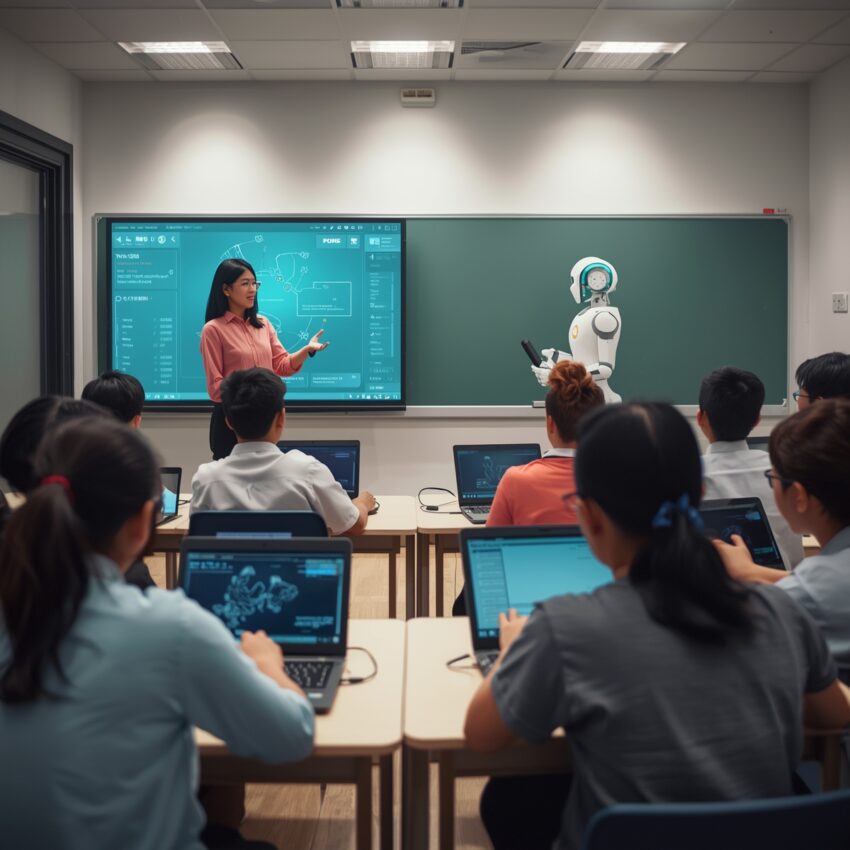
Singapore hasn’t fallen for extremes. Instead of asking “AI or Teachers?”, it asks “How can both thrive together?” In classrooms, technology supplements lessons. Teachers use digital tools to visualize complex topics, while AI systems track progress and offer micro-feedback. The result is harmony – not replacement.
Singapore’s model acknowledges that AI’s strength lies in data precision, while teachers’ strength lies in intuition. It’s a blend that prepares children for both academic success and emotional intelligence. A student mastering Science or Math might rely on AI-driven quizzes but the ability to collaborate, communicate and think critically still comes from guided discussion – a teacher’s domain.
A Future-Ready Child Needs Both
Let’s not romanticize the past or worship the future. The truth sits in the middle. Children today will live in a world where AI isn’t an option – it’s infrastructure. So yes, they must learn how to use it, question it and grow with it. But they’ll also need the emotional depth that no algorithm can teach. Confidence, compassion, creativity – all things that come from human mentorship.
AI gives instant feedback on a Math question but a teacher explains why the mistake happened and encourages a new approach. AI provides endless exercises, the teacher builds the mindset to persist through them. That’s the partnership Singapore is building.
The Real Future of Learning
The future of learning in Singapore isn’t binary. It’s hybrid, dynamic and deeply human. AI is powerful but teachers are irreplaceable. Together, they make education smarter and kinder.
In the end, a future-ready child isn’t one who just learns fast – but one who learns meaningfully. A child who can adapt to technology without losing the ability to feel.
AI will evolve but so will teaching. And perhaps that’s the real answer Singapore is giving to the world:
You don’t choose between AI and teachers. You teach them to work together – so children can thrive beyond both.
