
Executive Summary:
- Trigonometry is an important mathematics topic for many students today. Concept clarity matters greatly here.
- Many students struggle because they memorise formulas without understanding concepts properly. Confusion appears during application questions and calculations. So, understanding matters more than memorisation.
- Regular revision, visual charts and practice exercises improve mathematical confidence gradually. Repetition usually strengthens memory retention significantly. Consistency supports stronger performance.
Trigonometry is an important topic in mathematics learning today. Many students initially find trigonometric concepts confusing. Understanding improves confidence gradually. Special angles appear frequently during mathematics examinations and practice questions. Strong foundations are usually required for accurate problem-solving. Concept clarity matters greatly.
Students who understand angle relationships usually solve questions more confidently. Mathematical reasoning is also strengthened through regular practice. Consistency supports stronger learning.
Many students ask what is trigonometric ratios during early trigonometry lessons. Simple explanations often improve understanding significantly. Preparation reduces confusion. Some students also attend PSLE maths tuition programmes for guided mathematical support and revision. Structured learning often improves confidence steadily.
What Is Trigonometric Ratios?
Students often wonder what is trigonometric ratios during mathematics lessons. Trigonometric ratios describe relationships between triangle sides and angles.
These ratios are usually applied within right-angled triangle questions. Angle measurements determine the ratio values directly. Understanding improves calculation accuracy.
Trigonometric concepts also support advanced mathematics and science topics later. Strong foundations help students progress confidently. Learning builds gradually.
The Three Main Trigonometric Ratios
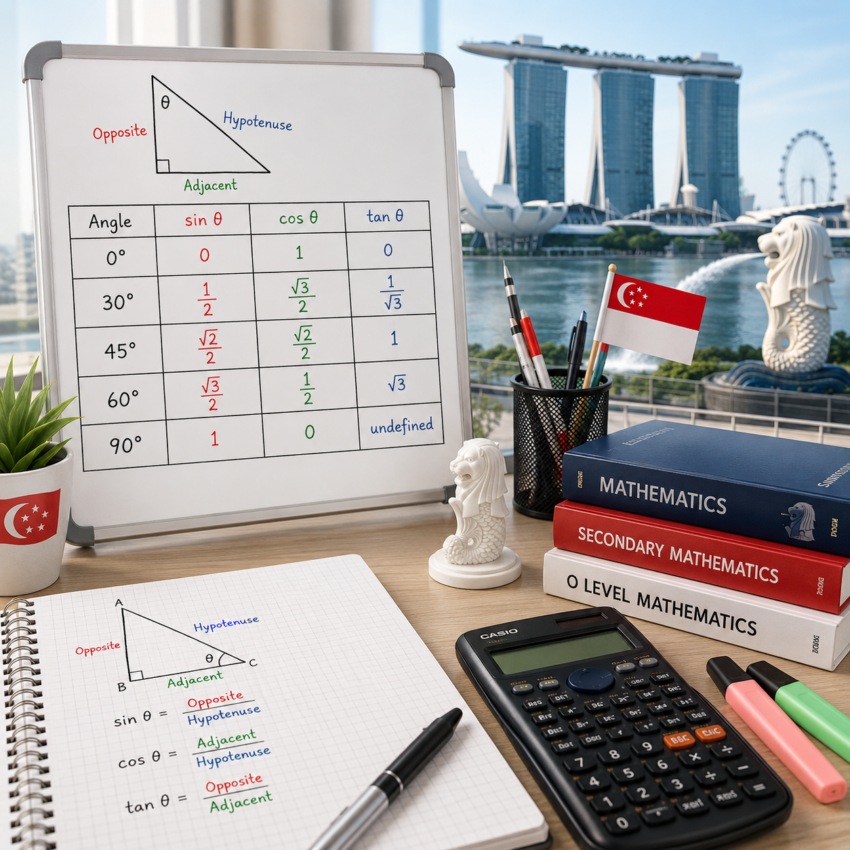
Students should understand the three basic trigonometric ratios clearly. These formulas appear regularly during mathematics examinations. Practice strengthens memory retention.
-
Sine Ratio
The sine ratio compares opposite and hypotenuse triangle sides. The formula is written as sin θ. Opposite sides face the angle. The sine ratio is commonly used during height and distance problems. Accurate side identification improves calculation accuracy significantly. Organisation supports better understanding.
-
Cosine Ratio
The cosine ratio compares adjacent and hypotenuse triangle sides. The formula is written as cos θ. Adjacent sides touch the angle. Cosine questions also appear frequently during trigonometry exercises and examinations. Students should identify triangle sides carefully. Attention improves accuracy greatly.
-
Tangent Ratio
The tangent ratio compares opposite and adjacent triangle sides. The formula is written as tan θ. This ratio excludes the hypotenuse. Tangent problems often involve angle calculations and triangle measurements regularly. Clear understanding improves confidence significantly. Practice supports stronger problem-solving.
Why Special Angles Matter
Special angles simplify trigonometric calculations during mathematics questions greatly. Students should memorise these angle values carefully.
The most common special angles are 0° 30° 45° 60° and 90°. These angles appear regularly during assessments. Familiarity supports faster calculations. Students who memorise special angle values usually solve questions quicker. Confidence also improves through repeated practice experiences.
Trigonometric Ratios for 0°
The angle 0° represents a completely horizontal direction mathematically. Certain trigonometric values become very simple here. Understanding starts with basics.
For 0°:
- sin 0° = 0
- cos 0° = 1
- tan 0° = 0
These values should remain memorised carefully during revision periods. Practice improves memory retention significantly. Consistency supports stronger recall. Students often confuse sine and cosine values initially sometimes. Repetition usually improves understanding gradually. Patience is very important.
Trigonometric Ratios of 30 Degree
The 30° angle is a common angle used in trigonometry in questions and diagrams. Students should memorise these values confidently. Practice strengthens familiarity.
For 30°:
- sin 30° = 1/2
- cos 30° = √3/2
- tan 30° = 1/√3
These values are usually applied during triangle calculation problems regularly. Correct substitution improves answer accuracy significantly. Organisation supports better performance. Students may also simplify tangent values into rationalised forms sometimes. Mathematical presentation should remain neat and organised. Clarity improves readability greatly.
Trigonometric Ratios for 45°
The 45° angle produces equal triangle side relationships naturally. Calculations often become simpler with this angle. Patterns improve memorisation.
For 45°:
- sin 45° = √2/2
- cos 45° = √2/2
- tan 45° = 1
Sine and cosine values remain equal at 45° exactly. Students should remember this important relationship carefully. Recognition improves speed greatly. Certain examination questions involve 45° right-angled triangle diagrams frequently. Familiarity improves confidence during problem-solving. Practice strengthens understanding.
Trigonometric Ratios for 60°
The 60° angle is another important special trigonometric angle regularly. Students should compare these values with 30° carefully. Patterns support memorisation.
For 60°:
- sin 60° = √3/2
- cos 60° = 1/2
- tan 60° = √3
Sine and cosine values switch positions compared with 30°. Observation improves understanding significantly. Patterns simplify learning greatly.
Trigonometric Ratios for 90°
The 90° angle represents a complete right angle mathematically. Certain trigonometric values behave differently here. Understanding remains important.
For 90°:
- sin 90° = 1
- cos 90° = 0
- tan 90° = undefined
The tangent value becomes undefined because division becomes impossible. Students should remember this special condition carefully. Accuracy matters greatly. Certain students confuse undefined values during examinations sometimes. Careful revision usually prevents mistakes later. Preparation improves confidence.
Easy Ways to Memorise Special Angle Values
Students often struggle memorising trigonometric ratio values initially. Simple patterns usually improve memory retention greatly. Organisation supports easier learning. Students should practise writing ratio tables regularly during revision sessions. Repetition strengthens familiarity naturally. Consistency improves recall speed.
Visual charts also help students remember values more effectively sometimes. Diagrams simplify complicated information significantly. Visual learning improves understanding. Students may also use mnemonic techniques during revision periods regularly. Memory methods improve confidence gradually. Practice strengthens long-term retention.
Common Mistakes Students Make
- Many students memorise formulas without understanding triangle relationships properly. Confusion often appears during application questions. Understanding matters more.
- Some students identify triangle sides incorrectly during calculations sometimes. Mistakes usually affect final answers significantly. Attention improves accuracy greatly.
- Students may also forget special angle values during examinations unexpectedly. Regular revision reduces memory gaps naturally. Preparation supports confidence.
- Careless calculator usage also creates avoidable mathematical mistakes frequently. Students should check calculations carefully afterward. Verification improves accuracy.
Importance of Practice in Trigonometry
Trigonometry improves through consistent revision and question practice regularly. Mathematical confidence develops gradually through repetition. Practice strengthens understanding. Students should solve different trigonometry question types every week consistently. Exposure improves familiarity with mathematical patterns naturally. Variety supports stronger reasoning.
Mock examinations also help students prepare for assessment conditions effectively. Familiarity reduces stress during actual examinations. Preparation improves readiness greatly. Mistakes should always be corrected after practice exercises carefully. Reflection improves learning and prevents repeated errors later. Correction supports improvement.
How PSLE Maths Tuition Helps Students
Many students improve mathematics confidence through guided academic support regularly. Structured lessons simplify difficult mathematical concepts effectively. Support strengthens understanding. Weak topics are usually explained clearly. Learning becomes easier gradually.
Tutors also teach students what is trigonometric ratios using simple examples and diagrams. Complex concepts become more manageable through guidance. Explanation improves understanding greatly.
Many tuition programmes provide worksheets, revision exercises and mock tests regularly. Students become more familiar with examination expectations. Preparation strengthens confidence steadily. Tutors also correct mistakes carefully during practice sessions frequently. Feedback improves mathematical accuracy significantly. Guidance supports stronger progress.
Conclusion
Trigonometry is an important mathematics topic for many students today. Strong understanding improves problem-solving confidence significantly. Concept clarity matters greatly. Understanding improves application during examination questions.
FAQs
Why are special angles important in trigonometry?
Special angles simplify calculations and appear frequently during mathematics examinations.
Why do students struggle with trigonometry?
Many students memorise formulas without understanding triangle side relationships properly. Weak understanding creates confusion later.
What mistakes should students avoid in trigonometry?
Students should avoid careless calculations and incorrect side identification during questions. Attention improves accuracy significantly.
How does PSLE maths tuition help students?
PSLE maths tuition provides guided practice, revision and mathematical explanation regularly. Support strengthens understanding steadily.
Can weak students improve in trigonometry?
Yes. Consistent practice guidance and patience improve mathematical confidence gradually. Small progress creates stronger results.
