
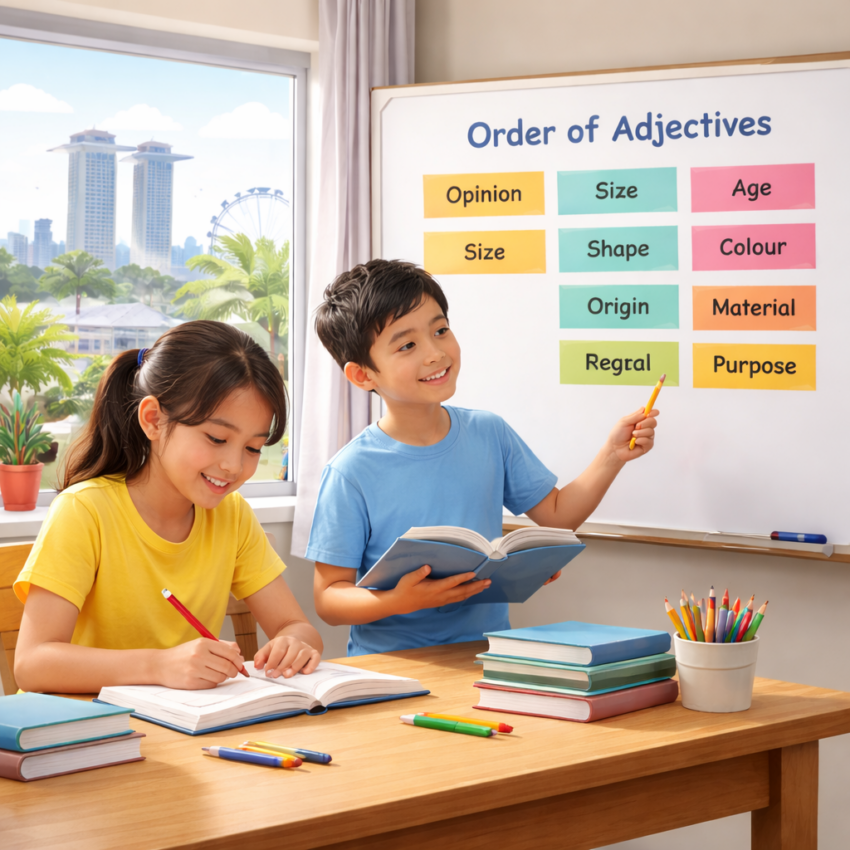
Executive Summary:
- Understanding the order of adjectives can transform how a student writes. It really can. Many learners already know what are adjectives but their placement is often mixed up.
- By following a simple structure opinion, size, age, shape, colour, origin, material and purpose students can arrange adjectives correctly. This rule is widely used and it is applied naturally by fluent speakers. With regular practice and exposure to adjectives examples, students begin to recognise patterns easily. It becomes automatic. Over time.
Getting adjectives in the right order can feel confusing at first. It often does. Many students know what are adjectives but the correct sequence is not always followed. Let’s break it down simply.
What Are Adjectives?
Adjectives are words that describe nouns. They add detail. They make language richer. And more precise.
Let’s look at an example:
“A beautiful small old round brown Italian wooden dining table.”
It may seem long but each adjective follows the correct sequence. These are practical adjectives examples that show how the rule works.
Breaking It Down with Simple Examples
Understanding improves with practice. Start small. Take a basic noun like “dress.” Now add adjectives step by step. “A beautiful dress.” “A beautiful long dress.” “A beautiful long red dress.” The sentence still sounds natural because each addition is made in the right order. Mistakes are reduced when this pattern is followed regularly. Practice makes it easier. Every time.
Common Mistakes Students Make
Students often mix up the order. It happens. They may place colour before size or opinion after material. These errors are common and they are usually noticed in exams. Sentences may lose clarity and marks can be affected. Awareness helps fix this. Quickly.
Tips to Master the Order of Adjectives
You can improve with a few simple strategies. First, learn the basic order and practise using it. Examples should be written daily and patterns must be recognised over time. Reading also helps and correct usage is absorbed naturally. Say sentences out loud. It helps you notice errors.
Another useful tip is to focus on common combinations like size and colour. These appear often and they are easier to remember. Build gradually.
The Role of Practice and Guidance
Some students learn this quickly. Others need support. With proper guidance, rules are explained clearly and mistakes are corrected early. Many parents choose PSLE English tuition to make sure their child understands grammar concepts. Confidence builds slowly. But surely.
FAQs
What are adjectives and why do they matter?
Words that describe nouns are called adjectives. They add detail. They help make sentences clearer and more interesting and meaning is enhanced when they are used correctly. Without adjectives, writing may feel plain and important details can be missed. They bring life to language.
Can you give some simple adjectives examples?
Yes, simple examples make it easier to understand. They help a lot. “A big red ball” is correct, while “a red big ball” sounds wrong. Patterns become clearer with practice.
How can PSLE English tuition help with grammar topics like adjectives?
Guidance from teachers can make a difference. It adds clarity. With PSLE English tuition, rules are explained clearly and practice is structured. Mistakes are corrected early and students are guided step by step. This helps them understand what are adjectives and use them correctly in exams. Support improves results.
