
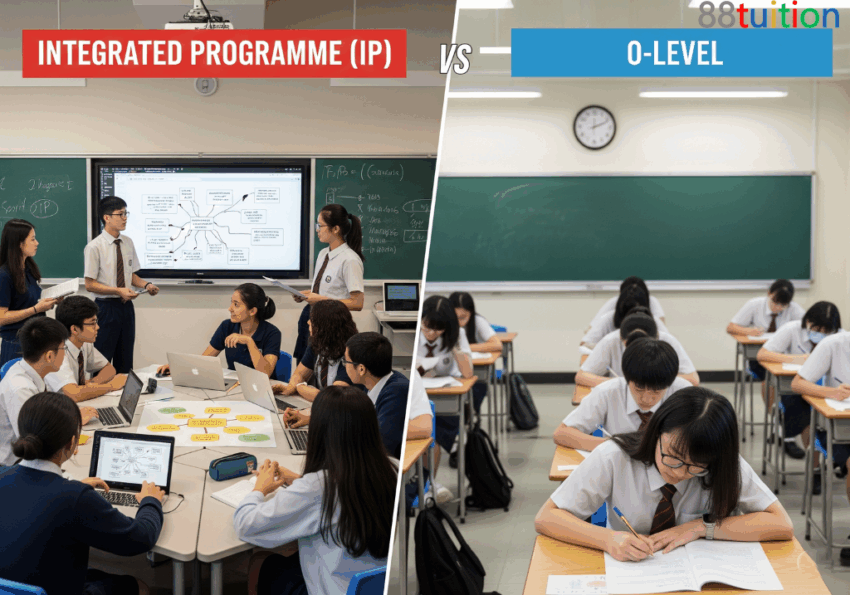
When it comes to choosing the right path for your child as a parent, it looks stressful and confusing. In Singapore, there are different education routes that can affect your child’s academic future. Two options that are the most talked about are the Integrated Programme (IP) and O- Level. Now, what is the difference between them, which one should you choose and how hard are they? Continue reading to know this!
What is the Integrated Programme?
The Integrated Programme is a special education track in Singapore that is provided in certain schools. It is specifically designed for students who have gained academic excellence and who wish to bypass the O-level exams. It is more of a direct route to the A-level and other educational options. The integrated program lets students take a streamlined and challenging curriculum that stretches across a longer period. It is usually from Secondary 1 to Junior College without the need for O levels.
What actually sets IP apart is that it focuses on a broader and more balanced learning approach. Students get more time in IP, as there is no O-level exam to prepare for. So, they get more time to focus on mastering their content, engaging in activities and deep learning. They also get a flexible schedule and it is a great advantage for the students who have different interests in areas like sports or arts.
What is the O-level?
The GCE O-level or the General Certificate of Education (Ordinary level) is the traditional route that students take at the end of their secondary school. After completing the PSLE secondary 4 exam, students sit for O-level exams in various subjects. This is what determines their academic progression.
This exam-based route is what more Singaporean students prefer and it is a common route. The O-level results show which post-secondary option your child can pursue. It is a structured way to know a child’s academic abilities.
Difference between the Integrated Programme and the O-level
So, now that we know what IP and O-level are, let’s see what the difference is between the two.
| Basis | Integrated Programme | O-Level |
|---|---|---|
| Structure | 6-year programme, Secondary 1 to JC, no O-Level exams, takes A-Level exams at the end |
4-year programme, Secondary 1 to Secondary 4, O-Level exams at the end |
| Curriculum | Flexible and accelerated | More exam-focused |
| Exams | No O-Level exams, focuses on A-Level preparation | O-Level exams after Secondary 4, results determine future academic options |
| Flexibility | More flexible | More rigid |
Disadvantages and Advantages of Integrated Programmes and O-level
| Aspect | Integrated Programme (IP) | O-Level |
|---|---|---|
| Advantages | No O-Level exams, focus on A-Levels | Clear structure & easy to follow |
| More time for in-depth learning, critical thinking and interdisciplinary studies | Well-defined academic path, leading to immediate post-secondary options | |
| Flexibility for students to pursue non-academic interests | Students specialise early with subjects based on their strengths | |
| Longer period for personal growth and exploration | Focused academic support before entering post-secondary education | |
| Disadvantages | High level of commitment required | Exam-heavy |
| Not every school offers IP | Less flexibility in the curriculum than IP | |
| Can be overwhelming for students who struggle with independent learning or require more guidance | May limit time for pursuing extracurricular interests during secondary years | |
| The long-term commitment might be challenging for some families, especially if the child faces difficulty along the way | Students with lower O-Level results may face limited post-secondary options |
Which is the better option for your child: Integrated Programme or O-Level
Choosing between IP and O-level depends on your child’s personality and learning style. Here are some factors that you can consider:
- If your child likes to learn and loves challenges, the IP route would be the perfect choice. It helps the students to focus more on in-depth learning without the pressure of giving the O-level exams. If your child also loves to play and excels in sports then they can also go for this route.
- If a student is more into an exam-based environment and likes to give exams to test their knowledge, the O-level route will be a better option. This route provides a clear and structured path that will progress into post-secondary education. Some students prefer that they get a more focused academic structure and then they make a decision on the basis of their O-level results.
Career Options after Integrated Programme and O-level
- After Integrated Programme:
Students go to pursue a university degree after completing the A-level exam. Some also opt for higher education abroad and pursue careers like law or medicine that require further professional training. IP Students can also start their
- After O-level:
For students who are aiming for university after A-levels. And polytechnic students who want to specialise in a certain field like engineering, business or media. O-level is also for vocational training in technical fields and some students also choose to enter the workforce directly.
Conclusion
Before going for the IP or O-level, it is important that you have an open conversation with your child. Find out in advance what your child’s academic goals, interests and strengths are. The most important thing is that the path your child chooses matches your child’s unique abilities and aspirations. If you choose the integrated program or O-level, both will lead you to success. It all comes down to which one is more suitable according to your child’s interests and strengths.
